Best Thermodynamics Books 2022 | Learn Where to Apply in Engineering Practice
Thermodynamics is the branch of physics that deals with the relationships between heat and other forms of energy. Thermodynamics is an important part of physics, chemistry, and engineering. Also, It's important because it controls interactions of everything in the universe. If you want to be an expert in this field, these best thermodynamics books 2022 will be the perfect choice for you.
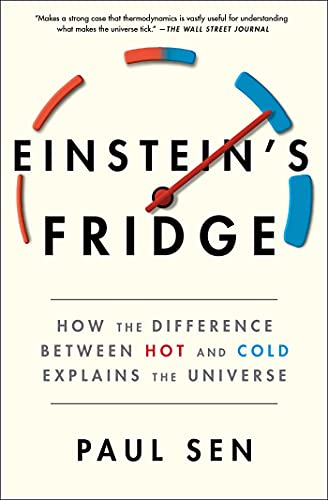
Thermodynamics is the branch of physics that deals with energy and entropy governs everything from the behavior of living cells to the black hole at the center of our galaxy. Not only that, but thermodynamics explains why we must eat and breathe, how lights turn on, the limits of computing, and how the universe will end.
The brilliant people who decoded its laws came from every branch of the sciences; they were engineers, physicists, chemists, biologists, cosmologists, and mathematicians. From French military engineer and physicist Sadi Carnot to Lord Kelvin, James Joule, Albert Einstein, Emmy Noether, Alan Turing, and Stephen Hawking, author Paul Sen introduces us to all of the players who passed the baton of scientific progress through time and across nations. Incredibly driven and idealistic, these brave pioneers performed groundbreaking work often in the face of torment and tragedy. Their discoveries helped create the modern world and transformed every branch of science, from biology to cosmology.
“Elegantly written and engaging” (Financial Times), Einstein’s Fridge brings to life one of the most important scientific revolutions of all time and captures the thrill of discovery and the power of scientific progress to shape the course of history.
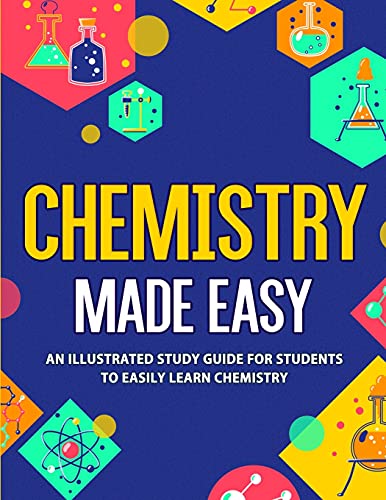
This book includes over 300 illustrations to help you visualize what is necessary to understand chemistry at it's core. While Chemistry is a huge topic, it's not necessary to spend years studying it unless it's your major in college. For most of us, we need a clear grasp on the subject to progress through school.
You will surely not be a chemistry newbie after reading this. You will learn that chemistry is about matter. You can break matter down a great deal all the way down to molecules, atoms, and subatomic particles. The smaller the matter, the more fascinating it gets.
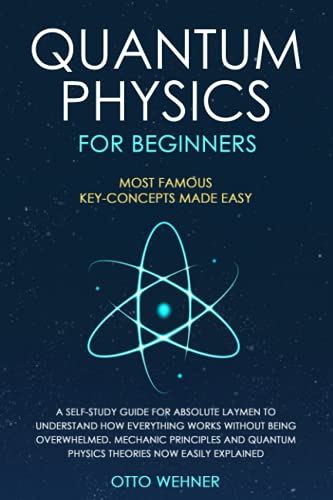
Learn about quantum physics in simple terms that anyone can understand with this book. It really is a fascinating subject to learn about. The author provides a detailed diagram on an atom which it the basics of physics. Quantum physics in itself is complicated. The author has attempted to break it down into its simplest parts. This book covers the applications and principles of Quantum Physics and Quantum Mechanics and points out that we are all impacted by both in our everyday lives even though we may not realize it. This was a fascinating and informative book.
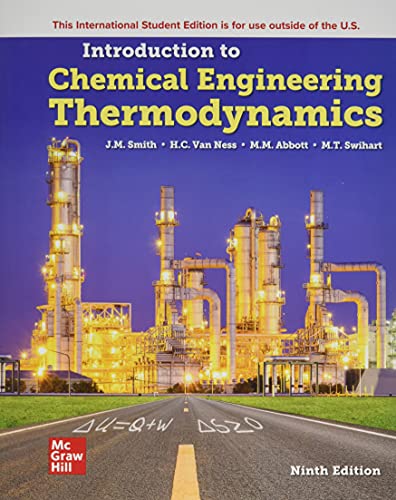
It does not come with online access code. Access code, if required by an instructor, sold separately at another ISBN. The content of International edition is the same as other formats. Introduction to Chemical Engineering Thermodynamics presents comprehensive coverage of thermodynamics from a chemical engineering viewpoint. The text provides a thorough exposition of the principles of thermodynamics and details their application to chemical processes. The chapters are written in a clear, logically organized manner, and contain an abundance of realistic problems, examples, and illustrations to help students understand complex concepts. This text is structured to alternate between the development of thermodynamic principles and the correlation and use of thermodynamic properties as well as between theory and applications.
This textbook provides an up-to-date pedagogical introduction to stochastic thermodynamics, guiding readers from basic concepts in statistical physics, probability theory, and thermodynamics to the most recent developments in the field. Gradually building up to more advanced material, the authors consistently prioritize simplicity and clarity over exhaustiveness and focus on the development of readers’ physical insight over mathematical formalism. This approach allows the reader to grow as the book proceeds, helping interested young scientists to enter the field with less effort and to contribute to its ongoing vibrant development. Chapters provide exercises to complement and reinforce learning.
Since its first publication in 1923, this volume has been considered one of the great books in the literature of chemistry. In the early 1960s, well-known chemists Kenneth S. Pitzer and Leo Brewer revised and updated it, adding substantial material on solution thermodynamics, results in statistical mechanics, surfaces, gravitational and electromagnetic fields, and other areas.
Upon the second edition's 1961 publication, The Journal of Chemical Education noted: "The book will undoubtedly resume its place as a constant guide and reference for chemists using thermodynamics in their research, and as a textbook and reference for classes in the application of thermodynamics to chemistry." This new edition of a foundational work will be welcomed by teachers in the field. For advanced undergraduates in chemistry and related fields.
The subject of thermodynamics deals with energy and has long been an essential part of engineering curricula all over the world. Its broad application area ranges from microscopic organisms to common household appliances, transportation vehicles, power generation systems, and even philosophy.
This introductory book contains sufficient material for two sequential courses in thermodynamics, and students are assumed to have an adequate background in calculus and physics. A conscious effort is made to emphasize the basic principles of thermodynamics while also providing students with a perspective of how computational tools are used in engineering practice. The traditional classical, or macroscopic, approach is used throughout the text, with microscopic arguments serving in a supporting role as appropriate. This approach is more in line with students’ intuition and makes learning the subject matter much easier.
This book will give you a working understanding of thermal physics, assuming that you have already studied introductory physics and calculus. You will learn to apply the general laws of energy and entropy to engines, refrigerators, chemical reactions, phase transformations, and mixtures. You will also learn to use basic quantum physics and powerful statistical methods to predict in detail how temperature affects molecular speeds, vibrations of solids, electrical and magnetic behaviors, emission of light, and exotic low-temperature phenomena. The problems and worked examples explore applications not just within physics but also to engineering, chemistry, biology, geology, atmospheric science, astrophysics, cosmology, and everyday life.

A preeminent physicist unveils a field-defining theory of the origins and purpose of life.
Why are we alive? Most things in the universe aren't. And everything that is alive traces back to things that, puzzlingly, weren't.
For centuries, the scientific question of life's origins has confounded us. But in Every Life Is on Fire, physicist Jeremy England argues that the answer has been under our noses the whole time, deep within the laws of thermodynamics. England explains how, counterintuitively, the very same forces that tend to tear things apart assembled the first living systems.
But how life began isn't just a scientific question. We ask it because we want to know what it really means to be alive. So England, an ordained rabbi, uses his theory to examine how, if at all, science helps us find purpose in a vast and mysterious universe.
10. Thermodynamics

Enrico Fermi (1901 - 1954) was an Italian-American physicist particularly known for his work on the development of the first nuclear reactor and for his contributions to the development of quantum theory, nuclear and particle physics, and statistical mechanics. He was awarded the 1938 Nobel Prize in Physics for his work on induced radioactivity. Fermi is widely regarded as one of the leading scientists of the 20th century, highly accomplished in both theory and experiment. Along with J. Robert Oppenheimer, he is frequently referred to as "the father of the atomic bomb." His lecture notes, especially those for quantum mechanics, nuclear physics, and thermodynamics, were transcribed into books that are still in print, including THERMODYNAMICS, which remains his most important publication. With his characteristic clarity, in this classic on Thermodynamics, Fermi explains the First and Second Laws of Thermodynamics, entropy, thermodynamic potentials, and much more.
Fully revised to match the more traditional sequence of course materials, this full-colour second edition presents the basic principles and methods of thermodynamics using a clear and engaging style and a wealth of end-of-chapter problems. It includes five new chapters on topics such as mixtures, psychrometry, chemical equilibrium, and combustion, and discussion of the Second Law of Thermodynamics has been expanded and divided into two chapters, allowing instructors to introduce the topic using either the cycle analysis in Chapter 6 or the definition of entropy in Chapter 7. Online ancillaries including a password-protected solutions manual, figures in electronic format, prepared PowerPoint lecture slides, and instructional videos are available.
Schaum’s Outline of Thermodynamics for Engineers, Fourth Edition is packed with four sample tests for the engineering qualifying exam, hundreds of examples, solved problems, and practice exercises to test your skills. This updated guide approaches the subject in a more concise, ordered manner than most standard texts, which are often filled with extraneous material.
Schaum’s Outline of Thermodynamics for Engineers, Fourth Edition features:
- 889 fully-solved problems
- 4 sample tests for the engineering qualifying exam
- An accessible review of thermodynamics
- Chapter on refrigeration cycles
- Nomenclature reflecting current usage
- Support for all the major leading textbooks in thermodynamics
- Content that is appropriate for Thermodynamics, Engineering Thermodynamics, Principles of Thermodynamics, Fundamentals of Thermodynamics, and Thermodynamics I & II courses
PLUS: Access to the revised Schaums.com website and new app, containing 20 problem-solving videos, and more.
This complete guide shows you, basic principals of thermodynamics. You can learn numerous applications of thermodynamics in our daily life. Also, every topic in this book organized in the way that anyone can understand easily
What You'll Learn-
-
Importance of thermodynamics in engineering practice
-
Understanding physics and physical arguments
-
Explanations of every concept
-
Numerous examples and figures

This book discusses every section of thermodynamics from the very basic. You can get all the laws of thermodynamics easily with complete explanations. Also, Advanced thermodynamics problems and solutions are added in this book.
What You'll Learn-
-
Explanations of thermodynamics system & laws
-
Thermodynamic potentials
-
The equation of gaseous equilibria
-
Fundamental facts of thermometry and calorimetry
-
The principle of Le Chatelier
-
The thermodynamics of dilute solutions
-
Detailed on entropy constant
This book discusses every section of thermodynamics from the very basic. You can get all the laws of thermodynamics easily with complete explanations. Also, Advanced thermodynamics problems and solutions are added in this book.
What You'll Learn-
-
Explanations of thermodynamics system & laws
-
Thermodynamic potentials
-
The equation of gaseous equilibria
-
Fundamental facts of thermometry and calorimetry
-
The principle of Le Chatelier
-
The thermodynamics of dilute solutions
-
Detailed on entropy constant
This hands-on guide helps you to score high in any thermodynamics course by offering easily understood, plain-English explanations. You can learn how energy is used in automobiles and so on. Also, It has everything you need to know about conserving mass and energy combustion process.
What You'll Learn-
-
The laws of thermodynamics
-
Essential properties and their relations
-
power thermodynamic processes
-
Chemical mixtures and reactions
-
Real-world applications of thermodynamic laws and concepts
-
Various problems
-
Step by step explanations of every topic
This amazing book provides basic laws and fundamental theorems of thermodynamics. You can learn all about thermal energy and its importance in our daily life. Also, it doesn't require any previous knowledge about thermodynamics because it contains from the very beginning to advanced level
What You'll Learn-
-
Fundamentals of thermodynamics
-
Practical applications
-
Relations with physics
-
Detailed on heat chemistry
-
Energy consumptions
-
Explanations of thermal energy
This complete guide provides the introduction to statistical mechanics and thermodynamics. Especially, It will be useful to students and workers in molecular biophysics and physical chemistry.
What You'll Learn-
-
Quantum statistical mechanics
-
polyatomic gas and configuration of polymer molecules
-
Lattice statistics, imperfect gases and dilute liquid solutions
-
Differential equations
-
Elementary quantum mechanics
This perfect book offers a full reference to thermodynamics for undergraduate engineering students. Also, it provides excellent examples and formal techniques for solving those problems. Moreover, many advanced topics are included for enriching your knowledge.
What You'll Learn-
-
Various modern applications of thermodynamics
-
Classical thermodynamics
-
Excellent examples and homework
-
Step by step solutions of every problem
This book offers you a selected set of exercises and problems. It has sufficient material to attain mastery of the concepts that will be found in most university-level thermodynamics courses. the book aims to improve your fundamental understanding of the material, as well as homework and exam performance.
What You'll Learn-
-
Terminology and notation key about major thermodynamics
-
Content mappings
-
Helpful Hints
-
Unique explanations on every complex topic
Fortunately for you, there's Schaum's. This all-in-one-package includes more than 500 fully solved problems, examples, and practice exercises to sharpen your problem-solving skills. Plus, you will have access to 20 detailed videos featuring instructors who explain the most commonly tested problems--it's just like having your own virtual tutor! You'll find everything you need to build confidence, skills, and knowledge for the highest score possible. More than 40 million students have trusted Schaum's to help them succeed in the classroom and on exams. Schaum's is the key to faster learning and higher grades in every subject. Each Outline presents all the essential course information in an easy-to-follow, topic-by-topic format. You also get hundreds of examples, solved problems, and practice exercises to test your skills.
What You'll Learn-
- 500 fully solved problems
- Four sample tests for the engineering qualifying exam
- Support for all the major textbooks for thermodynamics courses
This book provides a clear and mystery-free presentation of the central concepts in thermodynamics — probability, entropy, Helmholtz energy and Gibbs energy. It presents the concepts of entropy, free energy and various formulations of the Second Law in a friendly, simple language. It is devoid of all kinds of fancy and pompous statements made by authors of popular science books who write on this subject.
The book focuses on the Four Laws of Thermodynamics. As it is said in the dedication page, this book is addressed to readers who might have already been exposed to Atkins' book having a similar title. It challenges both the title and the contents of Atkins' book, Four Laws That Drive The Universe. One can glean from the title of this new book that the author's views are diametrically opposed to the views of Atkins.